
Education: A Foundation for Development
Education is a powerful driver of personal growth, social progress, and national development. In Ethiopia, quality education equips children and young people with the knowledge, skills, and confidence to build better futures and contribute to their families, communities, and country.
Despite significant progress in global literacy, 739 million youth and adults still lack basic literacy skills, while many children in low- and middle-income countries do not achieve minimum reading proficiency. Globally, adult literacy has increased from 65% in 1975 to more than 88% today, but major gaps remain, according to UNESCO.
Yet, access to education does not always guarantee quality learning. Many schools continue to face shortages of learning materials, laboratories, libraries, digital facilities, and adequate teacher support. Closing these gaps is essential to creating inclusive and supportive learning environments where every learner can reach their potential.
Reaching Communities beyond the Reach
For more than two decades, Kelem Ethiopia has worked to expand access to quality education, with a particular focus on hard-to-reach communities in Afar and Amhara regions.
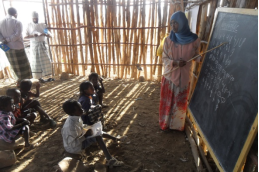
In Afar, the pastoralist way of life presents unique challenges to conventional education. Frequent movement in search of pasture and water, displacement caused by conflict, and damage to education infrastructure have interrupted children’s learning and kept many out of school.
In Amhara region, schools face different but equally serious challenges, including shortages of trained teachers, learning materials, functional classrooms, and laboratory facilities. Poverty and dependence on agricultural livelihoods can also push children into household and farm responsibilities instead of school.
These challenges are significant; but they are not insurmountable.
Bringing Education Closer to Afar’s Pastoralist Communities
For pastoralist communities, Alternative Basic Education (ABE) provides a flexible pathway to learning that better reflects their way of life. By bringing education closer to communities and allowing more flexible learning arrangements, ABE can help children continue their education despite seasonal movement and other barriers.
For girls and women, these opportunities can be particularly transformative. Household responsibilities, distance from schools, poverty, early marriage, and social norms can limit their access to formal education. Community-based and flexible learning can help remove some of these barriers and create opportunities for greater participation.

Considering this reality, Kelem Ethiopia has constructed, furnished and established 68 primary and Alternative Basic Education centers in Afar, helping bring learning opportunities closer to underserved communities. Kelem Ethiopia has supported the rehabilitation and furnishing of 168 schools along with comprehensive educational support that enhance both accessibility and quality of education while helping schools provide more conducive environments for teaching and learning.
Fighting illiteracy is not simply about teaching people to read and write. Literacy gives people the ability to access information, use essential services, manage livelihoods, understand financial opportunities, and make informed decisions. For women, young people, and rural communities, literacy can open doors to greater economic participation and social empowerment. That is why investing in education means investing not only in schools, but also in stronger families, empowered communities, and a more prosperous future.
Investing in Quality Education
Currently, Kelem Ethiopia with its partners, #Bundesministerium für wirtschaftliche Zusammenarbeit und Entwicklung (BMZ), #TERRA Projekte International e.V, #Aktion Deutschland Hilft, is supporting quality education through the Enhancing Education Quality Improvement (EQUIP) Project, working to improve education quality in 12 schools in Kombolcha City and Kalu Woreda of the Amhara Region benefiting 35,500 school community.The project supports schools through learning materials, teacher refresher training, and strengthened gender clubs. By working with students, teachers, school leaders, and education officials, the project aims to create safer and more positive learning environments and improve.
The project supports schools through learning materials, teacher refresher training, and strengthened gender clubs. By working with students, teachers, school leaders, and education officials, the project aims to create safer and more positive learning environments and improve educational outcomes.

Literacy: A Pathway to Prosperity
As we commemorate this years’ International Literacy Day under the theme “Literacy for People, the Planet and Prosperity,” we are reminded that literacy extends far beyond the classroom.
A literate individual is better positioned to access opportunities, make informed choices, support their family, and contribute to their community. When individuals gain knowledge and skills, families become stronger; when families are empowered, communities become more resilient.
Reducing illiteracy is therefore an investment in human potential, economic opportunity, resilience, and sustainable development.
Looking Ahead
Investing in education today means investing in an Ethiopia that is more skilled, inclusive,

resilient, and prosperous tomorrow. For Kelem Ethiopia, supporting quality education is more than a program; it is a long-term commitment to ensuring that children, girls, women, and underserved communities have the opportunity to learn, grow, and shape their own futures.
Because when literacy rises, communities rise.
Author: Hassina Oussman
